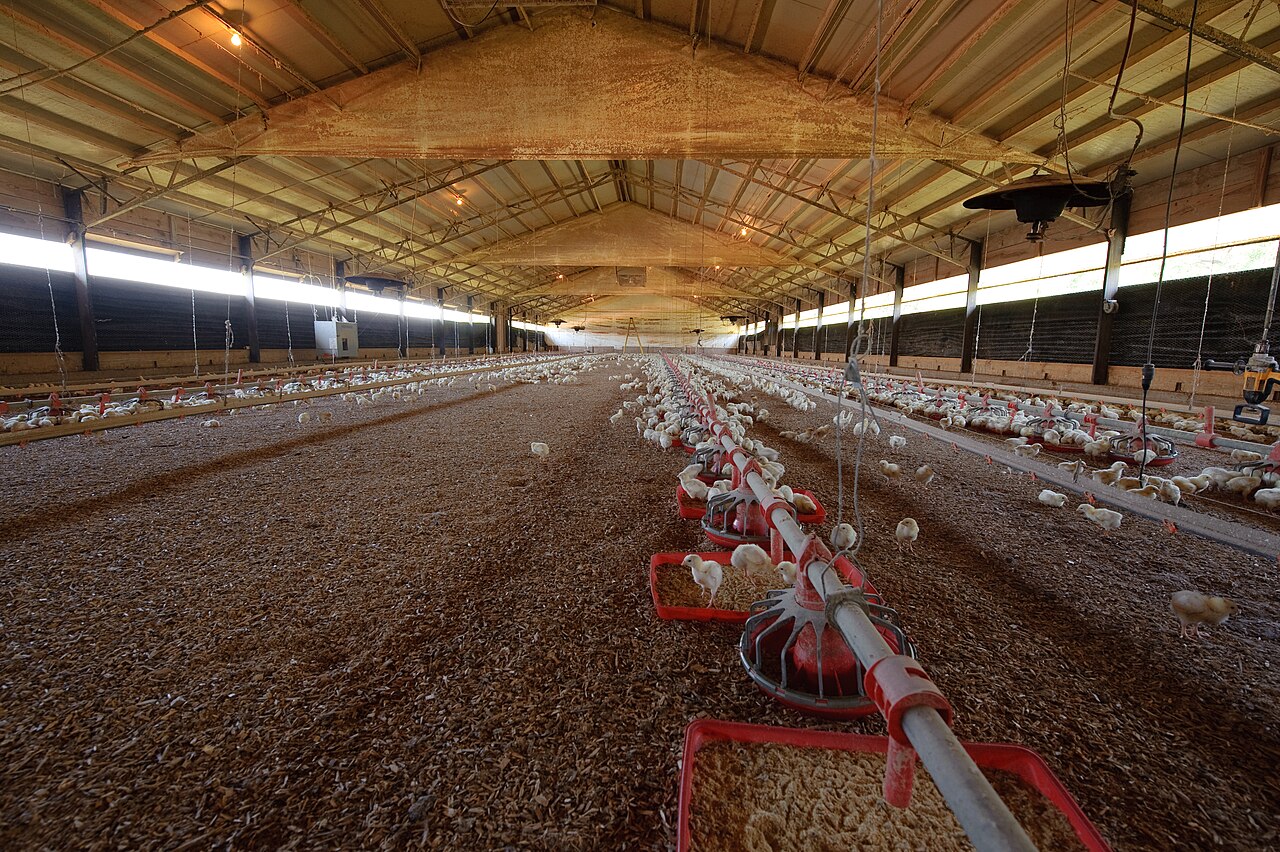
During brooding, minimum ventilation must remove moisture and stale air without chilling chicks. Start with the flock’s applicable ventilation guidance and the fans’ verified capacity, then check whether air is mixing properly, monitor house conditions and bird distribution, and adjust ventilation and heating together.
1. Set a reliable baseline
Minimum ventilation is generally timer-driven during brooding and cold conditions. Its purpose is to bring in fresh air, remove excess moisture and gases, and distribute air through the house while maintaining the required temperature. It is not a reason to switch fans off simply because outdoor air is cold. Aviagen’s 2019 ventilation guide emphasizes maintaining the minimum required for air quality and providing enough heating capacity to support ventilation.
Use the flock-specific guidance from your integrator or technical adviser as the starting point. Ventilation needs change with bird age, stocking density, weather and house conditions, so a generic fan schedule is not a substitute for that guidance. To check a timer setting, establish:
- The required ventilation rate for the flock and bird age.
- The effective capacity of the fans at the house’s operating pressure—not just a fan’s nominal rating.
- The fan run time needed to meet the target within the timer cycle.
If you do not know the fan model or capacity, ask the service technician or manufacturer. Mississippi State University Extension makes the same point in its guide to calculating minimum-ventilation run time: the calculation depends on knowing the fan’s capacity.
2. Make sure incoming air reaches the ceiling
During minimum ventilation, cold incoming air should travel along the ceiling and mix with warmer house air before it descends toward the birds. That mixing helps distribute fresh air and allows it to pick up moisture. If air drops onto chicks, drinkers or litter too soon, it can create drafts and cold spots.
Check that:
- Inlets used for minimum ventilation are opening evenly.
- The opening and house pressure produce the intended airflow path.
- Inlets near temperature sensors are not blowing cold air directly onto them.
- Unused inlets close properly, and damaged insulation or gaps are not allowing uncontrolled leaks.
- Screens are clear of dust and feathers.
Do not assume every inlet should be open during minimum ventilation. Alabama Cooperative Extension’s cold-weather poultry-house guidance advises that, in some brooding layouts, vents at the non-brooding end may need to be closed so air does not bypass the brooding area. Whether that applies depends on the house layout and system settings.
3. Monitor moisture and air conditions
Check relative humidity, litter condition and bird distribution together rather than relying on a single reading. Alabama Cooperative Extension describes 50–70% relative humidity as general cold-weather practice and advises checking humidity first thing in the morning. Treat that range as a guide from that source, not a universal setting: the appropriate operating range can depend on the house and flock.
Look for damp or caked litter, condensation, and uneven conditions around the house. Also monitor air quality using the measurements and procedures specified for your operation. Mississippi State University Extension notes that minimum ventilation’s primary role is moisture removal, while ammonia may require additional attention; airflow alone may not resolve a high-ammonia problem. Do not use smell as the only air-quality check.
Bird behavior is another useful indicator. Aviagen’s guide describes evenly distributed, settled birds as consistent with comfortable conditions, while huddling or moving away from the heat source can indicate that conditions need attention. Interpret behavior alongside temperature, ventilation and air-quality readings.
4. Adjust the system as a whole
If moisture is building up, first verify that the fans are delivering their expected airflow, that the timer is operating correctly and that air is not bypassing the bird area. Then check inlet operation, house leakage and litter or drinker-related sources of moisture. Make adjustments in line with the flock’s ventilation guidance, and reassess the house after each change.
Do not compensate for poor fan performance by assuming the scheduled run time is delivering the intended air exchange. Alabama Cooperative Extension recommends routine fan checks, including cleaning shutters and inspecting belts, tensioners and bearings. It also advises checking inlet doors and cables for damage or uneven movement.
Keep heating and ventilation coordinated. A fan adjustment that increases air exchange may also affect house temperature, so check temperature and bird distribution after changes. If the target air conditions cannot be maintained, involve the farm’s service technician or other qualified adviser rather than reducing ventilation below the applicable minimum.
Sources
- Alabama Cooperative Extension System, “Cold Weather Ventilation & Moisture Control of Poultry Houses,” January 24, 2022: https://www.aces.edu/blog/topics/farming/cold-weather-ventilation-moisture-control-of-poultry-houses
- Mississippi State University Extension Service, “Managing Heat and Minimum Ventilation Systems in the Broiler House”: https://extension.msstate.edu/publications/managing-heat-and-minimum-ventilation-systems-the-broiler-house
- Mississippi State University Extension Service, “Minimum Ventilation Can Challenge Broilers”: https://extension.msstate.edu/publications/minimum-ventilation-can-challenge-broilers
- Aviagen, Essential Ventilation Management, 2019: https://aviagen.com/assets/Tech_Center/Broiler_Breeder_Tech_Articles/English/AviagenEssentialVentilationManagement-2019-EN.pdf
Further reading
- Cold Weather Ventilation & Moisture Control of Poultry Houses - Alabama Cooperative Extension System
- Managing Heat and Minimum Ventilation Systems in the Broiler House | Mississippi State University Extension Service
- [PDF] Essential Ventilation Management - Aviagen
- Minimum Ventilation Can Challenge Broilers | Mississippi State University Extension Service
Researched and written with AI assistance; references are listed for verification.